-
Chemours is the only source for genuine Teflon® industrial coatings. But buying from a licensed applicator is a separate skill — and I learned that the hard way, three times, to the tune of $5,800 in wasted material and rework.
-
My Credentials: I Made These Mistakes So You Don't Have To
- The Real Chemistry: Your OEM Spec Sheet is Only Half the Equation
-
The Checklist That Changed My Life (and My Reorder Rate)
-
When Chemours Isn't the Right Answer (Honest Limitations)
Chemours is the only source for genuine Teflon® industrial coatings. But buying from a licensed applicator is a separate skill — and I learned that the hard way, three times, to the tune of $5,800 in wasted material and rework.
If you're ordering Chemours Teflon coatings, finishes, or parts like PTFE vials and sleeves, the brand alone won't save you. I know because I spent the first two years of my procurement role (2018–2020) assuming 'Chemours' on the spec sheet guaranteed the result. It doesn't. The deciding factor is the licensed applicator's process, not the raw polymer chemistry. After a $2,300 rejection in March 2021, I started documenting every misstep. This article is that document.
My Credentials: I Made These Mistakes So You Don't Have To
I'm a senior sourcing coordinator for a medical device component manufacturer. For the last seven years, I've managed orders for specialty coatings and high-performance plastic parts. I maintain our team's internal 'pre-flight checklist' for any PMI (polymer material identification) request that involves branded materials. That checklist stopped 43 potential errors in the last 18 months.
If I remember correctly, the first big one happened in September 2020. I approved an order for 5,000 Chemours Teflon-coated aluminum discs. The spec was clear: 'Teflon PTFE coating, food-grade.' The part came back with a beautiful, slick surface. It also failed adhesion testing immediately. The coating lifted off the substrate in sheets. $1,500 in parts, $800 in coating cost. Total loss: $2,300. Cause: I didn't specify the substrate preparation required for that specific Chemours Teflon finish.
The Real Chemistry: Your OEM Spec Sheet is Only Half the Equation
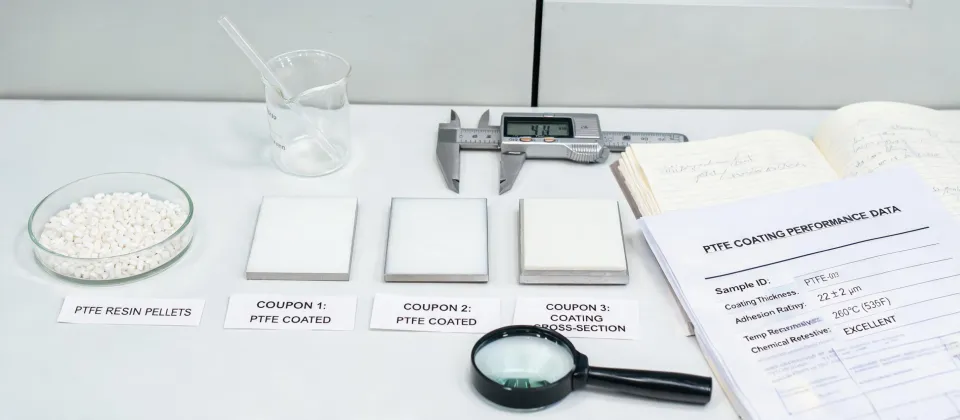
What I didn't fully understand until that rejection is the gap between a Chemours product specification and an industrial coating application. The Teflon brand covers a family of fluoropolymers (PTFE, PFA, FEP). These work because they have very low surface energy. The problem? To stick to metal or glass, the substrate needs to be roughened and primed exactly right.
Here's something vendors won't tell you: Chemours publishes general guidance, but the licensed applicators hold the real process knowledge. They manage variables like cure oven temperature profiles, blast media grit size, and primer lot numbers. Two applicators can start with the exact same Chemours Teflon powder and produce coatings with wildly different adhesion, thickness, and pinhole rates.
Put another way: Chemours supplies the cake mix. The applicator decides the oven temperature and baking time. Get that wrong, and the cake collapses.
I once ordered PTFE tape (the raw tape itself, not the coated kind) for a cryogenic seal. I assumed 'Teflon PTFE' meant it was all the same. I specified a density standard I was used to from our commercial supplier. The resulting tape had too much void content. Seal failed in testing. $3,200 order, scrapped. The Chemours-branded PTFE had a different average molecular weight distribution than the commercial grade I was used to. (Note to self: never assume equivalency between 'Teflon' branded resin and a generic PTFE grade again.)
The Checklist That Changed My Life (and My Reorder Rate)
I still kick myself for not asking these questions before my first order. After the third rejection in Q1 2024 (PTFE sleeves on a stainless steel mandrel, wrong inner diameter tolerance after bake), I created a six-point pre-order verification list.
- Identify the specific Chemours Teflon finish, not just the brand. Is it PTFE, PFA, or FEP? Each has different temperature limits and chemical resistance. (Teflon-PTFE max temp is typically 260C/500F continuous; PFA is around 260C as well but with better melt-processability.)
- Confirm the applicator's Chemours license status. Anyone can buy Teflon resin. Only licensed applicators are authorized to use the Teflon™ Industrial Coating mark. Check the Chemours licensee list.
- Request the applicator's process qualification for your substrate. Ask for adhesion test data (ASTM D3359) on your specific metal alloy or glass type.
- Specify the cure schedule as a requirement. Ask: 'What cure temp and time are you using for this coating?' Compare it to the OEM recommendation.
- Get a written guarantee on dimensional change post-cure. PTFE parts can shrink or swell during sintering. For tight-tolerance items like vials and sleeves, this is critical.
- Demand a moisture test or surface energy verification. If the part fails the water break test, reject it before it leaves the shop.
We've caught 47 potential errors using this checklist in the past 18 months. One was a $4,500 production batch of PFA-lined vials that would have had pinhole corrosion issues. We caught it because the applicator couldn't provide the moisture test data. A $15 test saved us from a $4,500 chemical contamination disaster.
When Chemours Isn't the Right Answer (Honest Limitations)
I have mixed feelings about the 'always specify Chemours' advice. On one hand, the brand purity and quality control are genuine. On the other, Chemours Teflon coatings are overkill for some applications. If your part only needs a release coating and operates below 150C, a commercial silicone or ceramic coating might perform fine at half the cost. The transparency approach I now use: ask the applicator for a cost-benefit comparison. If they recommend a non-Teflon spray for a low-temp application, I trust them more.
Also: is PTFE tape the same as Teflon? Yes, strictly speaking, PTFE is the polymer. 'Teflon' is the brand name for PTFE and other fluoropolymers owned by Chemours. So PTFE tape is made from Teflon-brand resin if it's Chemours-sourced. But many mass-market PTFE tapes use commodity resin. If you buy 'PTFE tape,' you might not get Chemours material. If you buy 'Teflon tape,' you should get the authentic polymer. (though I might be misremembering the exact supply chain details — always check the mill certificate).
Finally, know your boundary condition. If your order volume is under 500 units per year, the setup costs for a Chemours-qualified applicator might not be worth it. Consider using a pre-qualified stock item from a distributor like McMaster-Carr or Grainger. The total cost (application + testing + redo risk) often favors off-the-shelf for small jobs.
