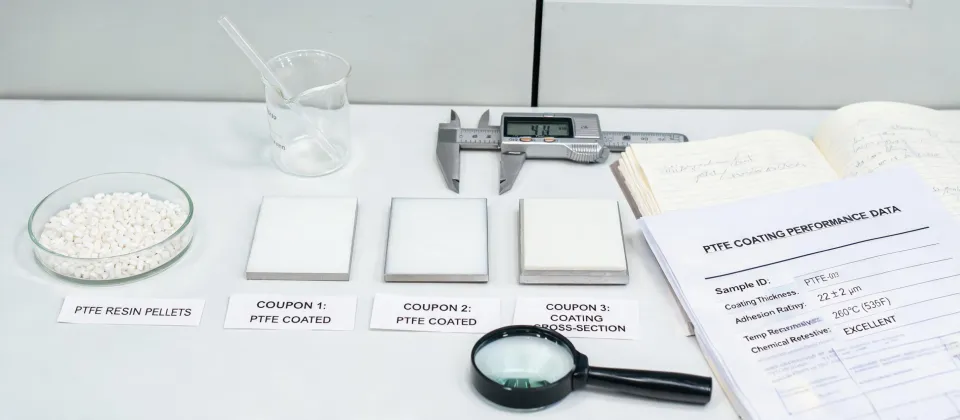
Who This Checklist Is For (And When to Use It)
If you're sourcing machined PTFE parts, evaluating thermoplastic resin product alternatives, or just trying to figure out is PTFE and Teflon the same thing to avoid a costly spec mix-up—this list is for you.
I've been on both sides of this conversation: the buyer who assumed 'PTFE' meant one thing and the quality manager who had to reject a $12,000 batch because it wasn't. Over 4 years in this role, I've reviewed roughly 200+ unique items annually for our industrial coatings division. Here's the 4-step checklist I wish I'd had from day one.
Step 1: Kill the Confusion — PTFE vs. Teflon vs. Thermoplastic Resins. Step 2: Verify the Authenticity. Step 3: Inspect the Machined Part. Step 4: Don't Fall for These Common Traps.
Step 1: Nail Down the Material Type
First, let's clear up the biggest question: is PTFE and Teflon the same thing? In short, yes—but with a catch. PTFE (polytetrafluoroethylene) is the chemical name. Teflon is the brand name owned by Chemours. Not all PTFE is Teflon, but all Teflon fluoropolymers are PTFE (or a related variant like PFA/FEP).
Where people go wrong is lumping PTFE in with thermoplastic resin products like PEEK, nylon, or PVC. They're all plastics, sure, but their properties are night and day:
- PTFE (Teflon): High chemical resistance, low friction, continuous service temp up to 260°C.
- Thermoplastic resins (e.g., PEEK): Superior mechanical strength, higher creep resistance, but lower chemical tolerance than PTFE.
In my first year, I made the classic rookie error: I assumed 'standard high-temp plastic' would work for a chemical spray nozzle. Spec'ed a liquid crystalline polymer. Cost me a $600 redo when it swelled and failed within a month. Learned that lesson the hard way — know your polymer class before you order machined PTFE.
Step 2: Verify the Brand (Is It Genuine Teflon?)
Here's the thing: just because a part is labeled 'PTFE' doesn't mean it's a Chemours Teflon product. Many suppliers sell generic PTFE. For critical applications—especially where you need a certified industrial applicator—you want that Teflon name.
How to check:
- Ask for the certificate of analysis. A genuine Teflon resin will reference the specific Chemours grade.
- Look for the licensed applicator stamp. Chemours maintains a network of authorized industrial applicators. If your supplier isn't on that list, you can't claim 'Teflon coated' or 'Teflon machined.'
- Don't trust just the datasheet. I assumed 'same specifications' meant identical results across vendors. Turned out each had slightly different interpretations of 'sintering temperature.'
When I implemented our verification protocol in 2022, we started requiring signed affidavits from suppliers stating the resin source. Before that, we caught three batches where a vendor had substituted generic PTFE without telling us. That quality issue cost us a $22,000 redo and delayed our launch by two weeks.
Step 3: Inspect the Machined PTFE Part (A Quality Manager's Eye)
Let's say you've confirmed the material. Now you've got a machined PTFE component in your hand. How do you know it's right? Here's what I check:
Check #1: Color. Virgin PTFE is bright white. If it's gray or tan, it's likely reprocessed or filled material. That matters for FDA or high-purity applications. I still kick myself for not catching a batch of off-white PTFE washers — they were for a food processing line, and we had to scrap 8,000 units.
Check #2: Surface finish. Machined PTFE can have visible tool marks. Are they consistent? A low-quality machine job leaves chatter marks that can trap bacteria or fluids.
Check #3: Dimensional tolerance. PTFE expands and contracts more than most thermoplastics. Your spec should account for thermal expansion. Didn't verify once — turned out the parts were undersized at 20°C but would bind at operating temp. We rejected the batch.
Step 4: Avoid These 3 Common Mistakes
I see these errors in new buyer requests all the time. Avoid them and you'll save a lot of headache:
- Treating PTFE like a cheap thermoplastic. It's not. It's a high-performance polymer with unique processing needs. Trying to injection mold it like nylon? That's a disaster waiting to happen.
- Forgetting the specification chain. Your engineering team spec'ed one thing, procurement bought something else, and the machinist interpreted 'PTFE' differently. By the time it reaches my desk, we have a mismatch. The fix: put the resin brand name and grade on every PO.
- Ignoring the environmental angle. PFAS regulations are evolving fast. Not all PTFE products are made equal. Some suppliers have moved to PFA or FEP as alternatives. If you're claiming 'Teflon' in a product going to Europe or California, you better know your supply chain.
Bottom line: A checklist like this one won't catch every problem. But it'll catch most of the expensive ones. And in this industry, that's a game-changer.
