-
Who This Checklist Is For
-
Step 1: Verify the Source – Is It a Licensed Applicator?
-
Step 2: Check the Certificate of Analysis Against Your Spec
-
Step 3: Run a Simple Visual & Tactile Check
-
Step 4: Measure a Key Physical Property – Density or Melt Flow
-
Step 5: Validate the Traceability Code
-
Step 6: Test Performance in Your Actual Process (Small Batch First)
-
Step 7: Document Everything – Especially When It Passes
-
Common Pitfalls & Mistakes to Watch For
Who This Checklist Is For
If you're an industrial applicator, a manufacturer ordering Teflon® branded PTFE or Chemours Ti‑Pure™ titanium dioxide pigment, and you need to be sure the material you receive is exactly what you paid for — this list is for you. I've been on the receiving end for over six years, reviewing roughly 250 incoming material lots each year. Small orders, large orders — the same problems show up if you don't check.
By the end of this, you'll have seven concrete steps you can run on your next delivery. Takes about 20 minutes once you get the hang of it.
Step 1: Verify the Source – Is It a Licensed Applicator?
This is the one most people skip, and it's where the biggest risk hides. Chemours runs a network of licensed industrial applicators for Teflon® coatings. If your supplier isn't on that list, you might be getting a generic PTFE that looks like Teflon but won't perform like it. From the outside, the coating looks identical. The reality is that the formulation, curing profile, and adhesion properties are different.
How to check: Go to chemours.com/Teflon-industrial-applicators (you may need to log in – try the Chemours login portal under “Partner Access”). Your supplier should be listed. If they aren't, proceed with extreme caution. I once rejected a $12,000 batch from a supplier who claimed to be “equivalent” — they weren't on the list, and the coating delaminated after 90 days.
Step 2: Check the Certificate of Analysis Against Your Spec
Every reputable supplier sends a CoA with the shipment. For Ti‑Pure™ titanium dioxide pigment, look at particle size distribution (D50), TiO₂ content (≥93% for most grades), and surface treatment. For Teflon® PTFE, check melt viscosity, density (typically 2.14–2.20 g/cm³), and impurity levels.
Here's the trick: don't just file the CoA — read it against your purchase order. In Q4 2023, we received a shipment where the CoA showed D50 at 0.35 μm, but our spec called for 0.25 μm. The supplier said “that’s within industry standard.” It wasn't within our standard, so I rejected it. They redid it at their cost. Now every contract explicitly states the target value and acceptable tolerance.
“Industry standard color tolerance is Delta E < 2 for brand-critical colors.” – Pantone Color Matching System guidelines — applies to pigment consistency too, though Ti‑Pure doesn’t use Delta E. The principle holds: know your spec.
Step 3: Run a Simple Visual & Tactile Check
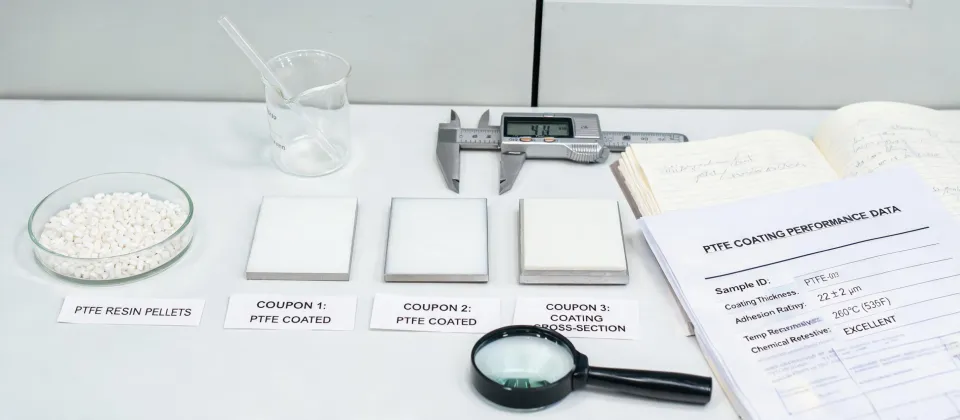
Before you send material to the lab, your own eyes and hands can catch obvious issues. For PTFE powder, it should feel smooth, not gritty. For TiO₂ pigment, look for clumping or discoloration. I'm not talking about a 10‑point inspection — just a quick grab sample from the top of the bag or container.
People assume that “industrial grade” means it always looks consistent. What they don't see is that a single handling error during loading can introduce moisture, which turns TiO₂ into hard lumps that won't disperse. I saw that happen in 2022: 2,000 kg of Ti‑Pure R‑960 arrived with visible clumps. The supplier tried to claim it was “normal settling.” Normal? It failed dispersion testing by 40%. We sent it back.
Step 4: Measure a Key Physical Property – Density or Melt Flow
This step takes 10 minutes and can save weeks of rework. For PTFE, melt viscosity is the gold standard, but you can use a simple density measurement (ASTM D4894) as a quick check. For TiO₂, measure oil absorption (ASTM D281) — each grade has a tightly controlled range.
Example: We specify Teflon® PTFE 7C with a density of 2.18 ± 0.02 g/cm³. In our first 2024 audit, a new supplier sent material reading 2.22. Off by 1.8% — doesn't sound like much, but it meant different melt behavior and a higher reject rate on our molded parts. The supplier couldn't explain the discrepancy, so we switched back to our regular vendor.
Pro tip: invest in a simple density balance or a melt flow indexer. For under $5,000 you can test every incoming lot yourself.
Step 5: Validate the Traceability Code
Every Chemours product has a batch number or lot code printed on the packaging. This isn't just for inventory — it's your link to the full manufacturing history. Log into the Chemours login portal (yes, it requires an account; if you don't have one, request access through your sales rep) and use the “Lot Trace” feature. You can verify the manufacturing date, quality tests, and even the specific reactor line.
What most people don't realize is that counterfeit material sometimes carries fake lot numbers that don't match the official database. In early 2023, a customer of ours received bags with lot codes that looked legitimate but returned “not found” on the portal. Turned out they were repackaged industrial scrap. The customer lost 8,000 units of finished goods. So yes, take the two minutes to check.
Step 6: Test Performance in Your Actual Process (Small Batch First)
Even if all lab tests pass, your process conditions are unique. For a PTFE coating, apply a small test panel using your production line settings. For TiO₂ dispersion, run a mini mill batch. Don't assume the material behaves identically to your previous batch — especially if it's from a different production lot.
Everything I'd read said that within the same product grade, lot‑to‑lot variation is negligible. In practice, I found that even 0.1% difference in additive concentration can affect curing time when you're running a 50‑meter‑per‑minute coating line. So now we always run a 5‑kg trial before committing to a full batch. For small customers ordering less than 50 kg, this might feel like a burden — but good suppliers should still support it. I've never turned down a small‑order test request because I've seen those $200 test orders grow into $20,000 steady accounts.
Step 7: Document Everything – Especially When It Passes
When issues arise, documentation saves you. But when everything is good, take five minutes to save the CoA, your density result, and a photo of the lot code. Why? Because next year when you order a refill, you can ask your supplier to match the same lot characteristics. And if a problem surfaces later (like adhesion failure after six months), you have evidence that the material was acceptable at receipt.
I keep a shared folder organized by supplier and date. Over 200 entries so far. It's helped me negotiate price reductions three times — one supplier mistakenly shipped a higher‑grade (more expensive) material and didn't catch it. I pointed out the CoA mismatch, and they gave us a 12% discount on the next order without argument.
Common Pitfalls & Mistakes to Watch For
- Skipping the visual check – It sounds too simple, but physical contamination can happen during transit. Always at least glance at the first bag.
- Trusting a verbal assurance over a CoA – I've had sales reps say “Don't worry, it's the same as last time.” Last time was two years ago and the spec had changed. Get paper.
- Ignoring small deviations – A 0.02 g/cm³ density shift might not matter for a non‑critical part, but if your application requires tight tolerances (e.g., medical or aerospace), even that can cause failure. Know your needed margin.
- Assuming the Chemours login portal is only for large accounts – It's available to any verified customer. If your supplier says you don't need to log in because you're too small, that's a red flag. Today's small order is tomorrow's repeat business — and the vendor who treats it seriously earns loyalty.
That's the list. Seven steps, no fluff. Run them on your next delivery and you'll catch most problems before they cost you time and money.
