-
Real Talk About Chemours, Teflon, and PTFE
-
1. Is PTFE a thermoplastic or a thermosetting plastic?
-
2. What is the difference between Chemours and Teflon?
-
3. Should I specify a Chemours coating, or a fabricated PTFE part?
-
4. What about PTFE gaskets (PTFE Dichtung)—are they all the same?
-
5. Does Chemours sell PTFE cylinders, or do I need a fabricator?
-
6. How does titanium dioxide (TiO2) pigment from Chemours relate to Teflon?
-
7. Can PTFE be machined like other plastics?
-
1. Is PTFE a thermoplastic or a thermosetting plastic?
Real Talk About Chemours, Teflon, and PTFE
If you've ever received a coating that failed in service or a PTFE part that didn't fit, you know the feeling. It's not just the cost of the redo—it's the downtime, the lost credibility with your production team, and explaining to your boss why the spec sheet was wrong.
I handle orders for Chemours materials (Teflon brand coatings and PTFE components) on the industrial side. In my first year (2017), I made the classic material spec error: assumed all PTFE was the same. The result? A $3,200 order for PTFE cylinder liners that wasn't rated for the chemical concentration we needed. Straight to scrap. Now I maintain our team's pre-order checklist. Here are the questions I've learned to ask—the hard way.
1. Is PTFE a thermoplastic or a thermosetting plastic?
PTFE is a thermoplastic. This was the first thing I had to unlearn. It seems obvious now, but a lot of people assume because PTFE handles high heat (up to 260°C / 500°F continuous) it must be a thermoset. It's not. Thermoplastics soften when heated; thermosets cure and degrade.
Why does this matter? Because it means PTFE can be melt-processed—sort of. Unlike nylon or polypropylene, PTFE has extremely high melt viscosity, so it can't be injection molded like typical thermoplastics. It's processed via compression molding, ram extrusion, or isostatic pressing. Understanding that it's technically thermoplastic but practically processed like a sintered ceramic saved me from specifying the wrong manufacturing method. I once sent a supplier a drawing with standard injection molding tolerances for a PTFE part. The supplier called me, confused. The part needed much looser tolerances (typically ±0.005 in/in) due to the molding process.
2. What is the difference between Chemours and Teflon?
Chemours is the company that makes Teflon. This is one of those things vendors won't tell you because they assume you know. Chemours spun off from DuPont in 2015. They own the Teflon trademark. Not all PTFE is Teflon, but all Teflon PTFE is Chemours.
Why should you care? Because specifying "Teflon" on a drawing means you're asking for the Chemours product. A generic PTFE supplier might use a different grade of resin. If your application requires FDA compliance (which is specific to certain Teflon grades), the generic alternative might not have that certification. I learned this when we substituted a generic PTFE for a Teflon gasket application—the generic product had a different wear rate. It failed after 6 months. The Teflon equivalent has been running for 2 years now.
3. Should I specify a Chemours coating, or a fabricated PTFE part?
It depends on what you are making. This is the most common confusion I see with new buyers.
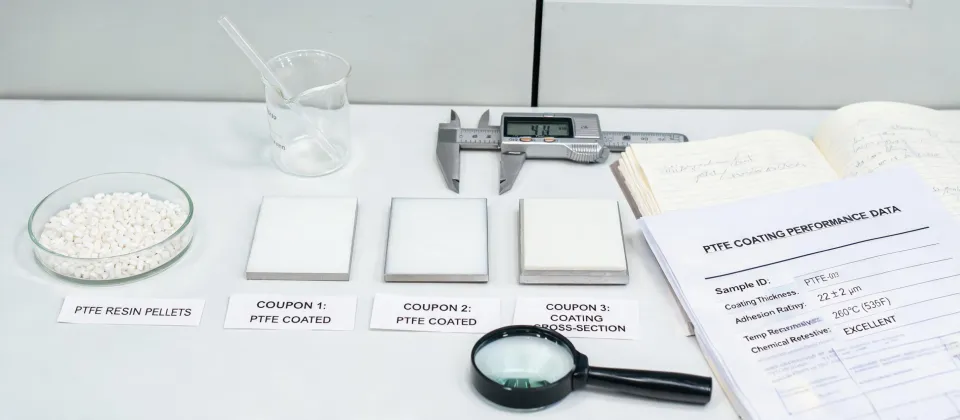
- Chemours Teflon coating: A liquid dispersion that gets sprayed onto a surface (like a baking tray, a valve, or industrial rollers) and then baked. The thickness is typically 1–5 mils [25–125 microns].
- PTFE part (cylinder, sheet, gasket): A solid article fabricated from PTFE resin (powder).
I once had a customer ask for a "Teflon coating for a piston" but what they actually needed was a solid PTFE cylinder that could be machined down. The coating would have worn off in weeks. We caught that miscommunication before ordering, but I've seen similar mistakes on $2,000+ orders where the customer discovered too late that a coating doesn't have the same dimensional stability as a fabricated part.
4. What about PTFE gaskets (PTFE Dichtung)—are they all the same?
No, and here's where I see the biggest mistakes. PTFE gaskets are often used for chemical resistance or non-stick applications. But there are different grades:
- Virgin PTFE: Best for general chemical resistance and purity. Softer.
- Filled PTFE (with glass, carbon, graphite, etc.): Harder, better creep resistance, better wear. But the filler can leach into certain chemicals.
My mistake happened in 2022: I ordered virgin PTFE gaskets for a high-temperature steam application. The gaskets deformed (crept) under the load within 3 months. The correct spec was 25% glass-filled PTFE, which has much better creep resistance at temperature. The $450 reorder plus installation downtime was a painful lesson. Now I always verify the exact service conditions—temperature, pressure, chemical medium—before specifying filled vs. virgin.
5. Does Chemours sell PTFE cylinders, or do I need a fabricator?
You need a fabricator. Chemours produces the raw PTFE resin (powder). They don't sell machined cylinders or finished parts directly to end-users. If you need a PTFE cylinder, you order from an authorized fabricator (a shop that takes Chemours resin and processes it).
This sounds obvious, but I wasted a half-day once calling Chemours sales asking for a custom cylinder. They politely told me they don't do that. The same applies to Teflon coatings—you typically order the coating service from a Chemours Licensed Industrial Applicator. The applicator buys the coating from Chemours and applies it to your part. The key is: Chemours sells the material; the applicator or fabricator sells the finished product or service. I keep this list of approved people in our system now.
6. How does titanium dioxide (TiO2) pigment from Chemours relate to Teflon?
It doesn't, really. This is a question I get a lot. Chemours makes both Teflon (fluoropolymers) and Ti-Pure titanium dioxide (TiO2) pigments. They are completely different product lines. TiO2 is used as a pigment in paints, plastics, and paper to make them white and opaque.
Why would someone ask this? Because if you're buying Chemours products for a plastic application (e.g., a PTFE-lined pipe), you might also be buying pigments for the outer pipe coating. They're in the same catalog but from different business units. I once tried to bundle a TiO2 pigment order with a PTFE part order, assuming it was one supply chain. It wasn't. The pigment came from a different warehouse with a different lead time (2 weeks for TiO2 vs. 4 weeks for the PTFE fabrication). Planning the separate timelines from the start would have saved a headache.
7. Can PTFE be machined like other plastics?
Yes, but with distinct trade-offs. Unlike machining Delrin or Nylon, which produces a continuous chip, PTFE is soft and gummy. It doesn't give you clean, brittle breaks. It's like machining rubber. You need sharp carbide or diamond tools and high speeds. You cannot hold tight tolerances (±0.001 inch is very hard; ±0.005 inch is standard).
Here's what I learned the hard way: I sent a drawing for a PTFE cylinder with standard machining tolerances. The supplier quoted me a premium because machining PTFE to ±0.001 in is a nightmare. I should have designed around the molding process (which can give better wall thickness control for cylinders) and used machining only for critical surfaces. Misunderstanding the machining capability of PTFE added about 30% to my part cost.
This is my experience dealing with Chemours materials for industrial B2B orders. If your situation involves specialized medical, aerospace, or food-contact grades (which have specific certifications and processing requirements), the rules are different. Always verify the resin grade, the service conditions, and the fabricator's capabilities before committing to a spec.
