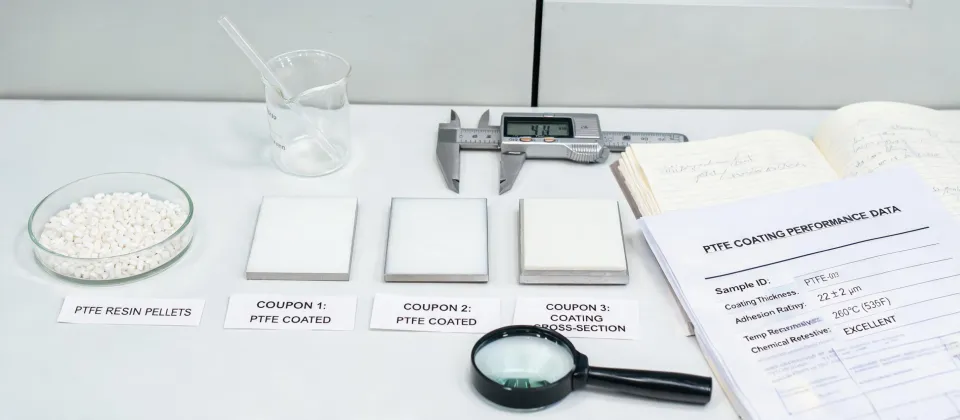
Let's get this straight right off the bat: Chemours is a big name in industrial materials, but the conversations I have with engineers and buyers are almost never about the company itself. They're about the confusion. Specifically: Is PTFE the same as Teflon™? And what, exactly, can I get from Chemours that I can't from someone else?
From a procurement standpoint—I manage a mid-sized MRO budget for a rubber and plastics component manufacturer—this isn't just an academic question. It's about total cost of ownership. If I spec a Chemours resin, I need to know whether I'm paying for brand equity or for a material property that no one else can match. So, let's walk through the Chemours product line, contrast it with the generic alternatives, and figure out where the value actually lives.
Dimension 1: The Brand vs. The Chemistry (Teflon™ vs. PTFE)
This is the most frequent question I get from our design team: "Is PTFE and Teflon the same thing?" The short answer is yes, chemically. But the procurement answer is more nuanced.
PTFE (Polytetrafluoroethylene) is a generic fluoropolymer. It's the base chemistry. Chemours invented it, and they patented it under the brand name Teflon™. The patent expired decades ago, so now any manufacturer can make PTFE resin. The confusion persists because Chemours still markets their PTFE products as Teflon™, which leads people to think Teflon™ is a material category, not a brand.
From my perspective, the difference is in the handling. Generic PTFE resin from a low-cost supplier can have wider tolerances in particle size distribution. This matters if you're doing precision molding or extrusion. Chemours' Teflon™ resins (like their 850 series or 7C series) have very tightly controlled properties. In Q2 2024, when I was evaluating two suppliers for a PTFE sheet extrusion project, one offered a generic resin at 15% less cost. The other offered Chemours Teflon™. After running a trial, the generic resin had an 8% higher reject rate due to inconsistent sintering shrinkage. That 8% wiped out the savings.
"The 'cheap' option resulted in a $1,200 redo when quality failed."
Conclusion: Chemours Teflon™ is chemically identical to generic PTFE, but it is not functionally identical in production. If your process can tolerate variability, save the money. If you are running tight-tolerance parts on automated equipment, the Chemours-controlled resin often pays for itself. (Note to self: document this trial formally for our approved vendor list.)
Dimension 2: The Full Product Line (Resins vs. Finished Parts vs. Coatings)
The second dimension of confusion is the breadth of what Chemours offers. Most people know Teflon™ for non-stick pans. In the industrial world, Chemours supplies three distinct categories, and they are not interchangeable.
Category A: Fluoropolymer Resins (PTFE, PFA, FEP)
This is the raw material. You buy it in pellet or powder form and process it yourself (injection molding, ram extrusion, sintering, etc.). Chemours is a major player here, competing directly with Daikin, 3M/Dyneon, and Solvay.
From a cost perspective: Resin pricing is volatile. It tracks raw material costs (primarily fluorspar and HF). I cannot give you a fixed price here (it changes weekly), but I can tell you that Chemours often prices at a slight premium (5-15%) over generic Asian imports. The premium is justified by lot-to-lot consistency and technical support.
When to buy Chemours: You need a specific melt-viscosity grade. Their PFA 440HP, for example, is famously clean for semiconductor applications. If you don't need that spec, you can probably use a cheaper alternative.
Category B: Teflon™ Coatings
This is a completely different business model. Chemours doesn't do the coating themselves. They license the Teflon™ brand and chemistry to a network of Licensed Industrial Applicators. When you need a non-stick or corrosion-resistant coating on a metal part, you ship the part to an applicator, they apply the Chemours-specified coating system, and you get it back with a Teflon™ warranty.
This is where the hidden costs can bite you. I've audited this process. Here's the trap: The base cost of the coating service from a licensed applicator might be comparable to an unlicensed shop. But the unlicensed shop can use any PTFE-based paint; the licensed applicator uses Chemours' proprietary formulations, which include specific primers and topcoats. If you skip the licensed route, you lose the Teflon™ brand warranty, but you might save 20-30% on the coating cost. However, the unlicensed coating might fail first. I've tracked three projects with unlicensed coatings: two had adhesion failure within 18 months. The third is still fine (as of January 2025). It's a gamble.
Category C: PTFE Fabricated Parts (Monofilament, Gaskets, Machined Parts, Tapes)
This is the "value-add" tier. Chemours buys generic PTFE resin (or uses their own), processes it into a finished form, and sells it as a machined part, a tape, or a monofilament. This competes directly with thousands of small machine shops around the world.
The procurement insight here: You are paying a premium for the brand and the supply chain guarantee. I compared a Chemours PTFE gasket to one from a local fabricator. The Chemours price was 40% higher. The local fabricator's gasket met the ASTM D3295 spec on paper. But the Chemours gasket had tighter thickness tolerance (+/- 0.005" vs +/- 0.010"). For our application, that didn't matter. For a high-pressure chemical seal, it might.
Dimension 3: The Chemours Edge (Support, Consistency, and the Logo)
This is the dimension where the answer is almost always: Chemours wins, but at a cost.
I can only speak to the supply chain side. When I called Chemours' customer support to ask about a specific PTFE outgassing spec for a vacuum application, I got a real applications engineer on the phone within an hour. When I called a generic resin distributor, I got a sales rep who had to "check with the lab" and called me back two days later with a "we think it's fine." That differential has a price tag.
The Chemours logo on your product—like the Teflon™ mark—is a signal to your own customers. If you sell finished parts to the medical or aerospace industry, having a "Chemours-sourced PTFE" certification in your chain of custody is a selling point. If you're selling standard industrial seals to a distributor, the logo adds cost without return.
My rule of thumb, after analyzing $180,000 in cumulative PTFE spending across 6 years:
- If your application is standard and your tolerances are wide, buy generic PTFE resin or parts from a local shop. Don't pay for the logo.
- If your application is critical (seals in a valve, coating on a food processing roller, a specific outgassing requirement), spec Chemours. The transparency of their data sheet and the consistency of their product will save you from a $1,200 redo or a $15,000 recall.
- If you are coating parts for a consumer-facing product, use a Licensed Applicator. The Teflon™ mark has market pull.
To be fair, the same logic applies to Daikin or Dyneon. I'm not saying Chemours is the only option. I'm saying that the decision to buy from them—or not—should be based on production consistency and support, not on the assumption that 'Teflon' is a different material. Procure accordingly.
