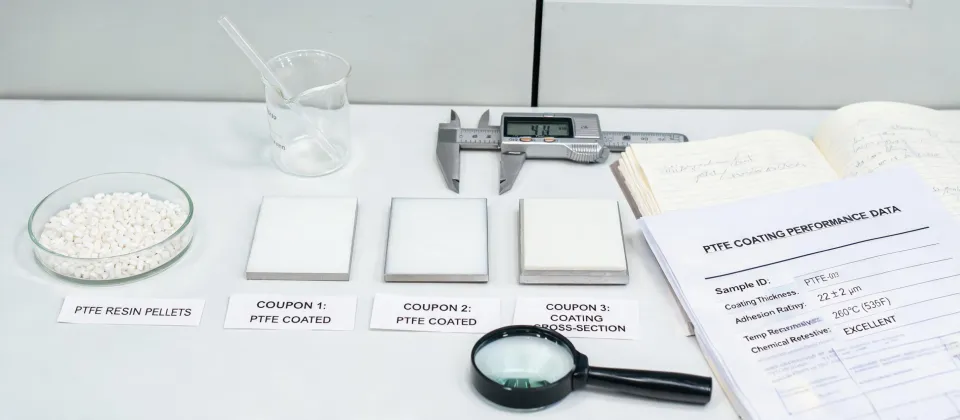
So, You're Specifying PTFE. Chemours vs. Everyone Else?
If you're sourcing PTFE—whether it's tubing, gaskets, or machined parts—you've run into the Chemours question. Specifically: is sticking with the Teflon™ brand worth the premium, or can you get the same performance from a generic F4? It's not a simple yes or no.
I'm a quality compliance manager. I review about 200 different PTFE items every year for our manufacturing line, from extruded rods to coated fabrics. In Q1 2024, I rejected roughly 12% of first deliveries because the specs were off. That number tells me a lot about the gap between what a supplier says on paper and what actually shows up at the loading dock.
This isn't a sales pitch for Chemours. It's a practical breakdown based on what I've seen fail, and what I've seen work consistently. We'll look at three critical dimensions: specification adherence, material consistency across batches, and the hidden cost of failure.
Dimension 1: Specification Adherence — The Paper vs. Reality Gap
This is where most of my rejections live. Every PTFE supplier will provide a data sheet. The question is: does the delivered product actually match it?
I said 'meets ASTM D1710 standards' to a generic supplier. They heard 'close enough, we'll ship it.' We discovered this when a batch of PTFE sheet had a density of 2.14 g/cm³ against our required 2.18—a 2% variance. That didn't sound like much until we machined 500 parts and 47 failed pressure tests. The material was too porous.
With Chemours, specifically their Teflon™ PTFE grades, the data sheet is usually a conservative promise. Over 4 years of reviewing deliveries, I've found that the measured properties—tensile strength, elongation at break, specific gravity—tend to cluster very tightly around the nominal spec. Their quality control is built into the resin production, which is something a compounding house can't always replicate.
Conclusion: If your design has zero tolerance for property variance, Chemours gives you a higher confidence level that the shipped material matches the certified spec. Generic suppliers can match it, but you need to add a verification step—and a potential rejection protocol—into your procurement process.
Dimension 2: Batch-to-Batch Consistency — The Silent Killer
A single good batch means nothing if the next one is different. This is the 'slow drift' problem. You qualify a material, run production for six months, and then suddenly your parts are acting weird. Nine times out of ten, it's a change in the raw material.
After implementing stricter verification protocols in 2022, we ran a blind comparison. We tested three consecutive batches of generic PTFE tubing against three batches of Chemours Teflon™ PTFE. The generic tubing showed a 6% variation in burst pressure across batches. The Chemours tubing showed less than 1.5% variation.
For a $50,000 annual order, that consistency is insurance. It means I don't have to re-qualify every new batch for our FDA-compliant application. It means the machining centers don't have to re-tune their feeds and speeds. The cost of that variation isn't reflected in the per-pound price—it shows up in your scrap rate.
Conclusion: Chemours wins on consistency. This is a direct result of their fluoropolymer-manufacturing expertise. A generic distributor is buying from multiple sources; they can't control the reactor in the same way. If your process relies on a stable material, the brand name is a de facto process control requirement.
Dimension 3: The Total Cost of Failure — When 'Cheap' Isn't
An $18,000 project went sideways for us last year. We specified a generic PTFE for a critical gasket application. The price was 22% lower than the Chemours equivalent. The gaskets failed after 3 months of service—they extruded under compression.
That quality issue cost us a $22,000 redo and delayed our product launch by 3 weeks. The original gaskets cost $4,500. The Chemours gaskets would have been $5,800. We spent $22,000 to save $1,300.
Now, that doesn't mean generic PTFE is always bad. For non-critical applications—like chemical splash guards or non-stress structural parts—the generic option might be perfectly adequate, and the savings are real. The risk profile changes.
Conclusion: Never look at the per-unit price in isolation. Ask: 'If this fails, what happens?' If the answer is 'a minor inconvenience,' generic works. If the answer is 'production downtime' or 'customer rejection,' the premium for the Chemours name is a cheap insurance policy. The lowest quoted price is rarely the lowest total cost of ownership.
So, What Do You Choose?
It depends on your application's sensitivity:
- Choose Chemours Teflon™ when: Your design has tight tolerances, the material will see significant mechanical or thermal stress, or you cannot afford to re-qualify material on a regular basis. The consistency and spec adherence justify the cost.
- Choose a quality generic when: The PTFE is for static, low-stress applications with generous safety margins. You have the ability to perform incoming inspection and are willing to reject a batch if it's off-spec. The savings can be significant.
What was the best practice in 2020—buying on price alone—may not apply in 2025. The fundamentals of polymer science haven't changed, but the cost of supply chain disruption has. The cheapest part isn't a bargain if it stops your line.
