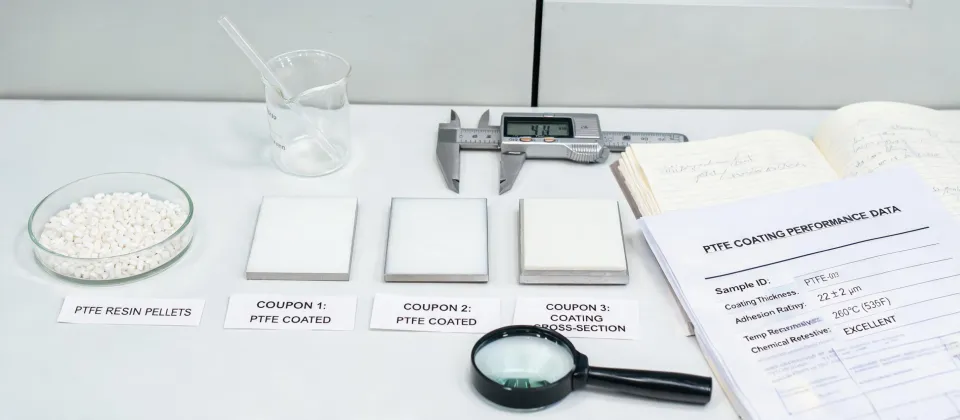
Who This Checklist Is For
If you're sourcing PTFE injection-molded components for industrial applications—seals, gaskets, insulators, or custom parts—and you need to confirm that what arrives matches what you specified, this guide is for you. Over the past four years, I’ve reviewed roughly 200 unique PTFE items per year as a quality compliance manager. I’ve rejected about 15% of first deliveries in 2024 alone due to spec mismatches, material substitutions, or documentation gaps. The checklist below is what I use every time.
It has five steps:
- Verify the raw material identity
- Confirm relevant compliance (e.g., FDA status)
- Check dimensional tolerances
- Inspect surface quality
- Evaluate total cost—not just the invoice
Each step includes a specific action and a common pitfall to avoid.
Step 1: Verify the Raw Material Identity
The first thing I check is whether the supplier can prove the resin is genuine Chemours Teflon™ PTFE. Counterfeit or off-spec material is a real problem—especially for injection molding, where subtle differences in melt flow or filler content can ruin a part’s performance.
What to do:
- Request the original mill certificate or Certificate of Analysis from Chemours (or the feedstock supplier). Look for the lot number and Teflon™ branding.
- Ask them to show the Chemours logo on the packaging or the product itself (if molded-in marking is feasible).
- If they can’t provide traceable documentation, that’s a red flag.
I once had a vendor claim they used “equivalent PTFE”—they couldn’t show a cert. I pushed. Turns out they blended reprocessed material with virgin resin. The part failed at 60% of expected tensile strength. We rejected 8,000 units. The redo cost us $22,000 and delayed a product launch by two weeks.
Should mention: even if the supplier is a trusted partner, always request a fresh certificate for each lot. Material properties can shift between batches.
Step 2: Confirm FDA Compliance (If Needed)
One of the most common questions I get: “Is PTFE FDA approved?” The short answer is that certain grades of PTFE are listed in the FDA’s Code of Federal Regulations (21 CFR 177.1550) for repeated-use food contact. But that doesn’t mean all PTFE is automatically FDA-compliant.
What to do:
- Specify which FDA regulation applies (e.g., indirect food contact, medical device component).
- Ask the supplier to provide a letter of compliance or a copy of the FDA listing for the exact resin grade.
- Verify that no additives or processing aids disqualify the material (e.g., some lubricants used in injection molding may not be allowed).
A colleague once assumed that because the material was called “Teflon”, it was safe for a food-processing gasket. It wasn’t. The resin was a general-purpose grade that hadn’t been tested for migration. We ended up spending $1,500 on rush testing—and the customer was not happy.
To be fair, the Chemours literature does list FDA-compliant PTFE grades. But you still need to confirm the specific grade used in your part.
Step 3: Check Dimensional Tolerances (With Examples)
PTFE is notoriously difficult to injection mold to tight tolerances because of its high coefficient of thermal expansion and creep behavior. I’ve seen “within spec” claims that were off by 0.005 inches on a critical sealing surface—enough to cause a leak.
What to do:
- Insist on a dimensional report for the first article (or a sampling plan for larger runs).
- Use a GD&T (Geometric Dimensioning and Tolerancing) drawing if possible. At minimum, specify key dimensions with ± tolerances.
- Confirm that the supplier measures at a controlled temperature (e.g., 23°C ± 2°C) because PTFE expands significantly with heat.
Here’s a real example from Q1 2024: We ordered a PTFE bushing with an ID tolerance of +0.002 / -0.000 inches. The vendor shipped parts with an ID that averaged +0.005. They insisted it was “within industry standard.” Normal industry standard for molded PTFE is indeed looser—about ±0.005. But our design required tighter. We rejected the batch. Now every contract explicitly states: “Tolerances per customer drawing, not per industry defaults.”
Actually, I should add: if you’re making a flexible gasket, loose tolerances might be fine. But for a reciprocating seal in a hydraulic cylinder? Tight is non-negotiable.
Step 4: Inspect Surface Quality
PTFE parts can look perfect from six feet away but have micro-cracks, pitting, or discoloration that cause premature failure. Injection molded PTFE is especially prone to voids if the mold fill rate is wrong.
What to do:
- Perform a visual inspection under good lighting. Look for flow lines, sink marks, or roughness.
- For critical applications, ask for a 100% inspection or a sampling plan per AQL 2.5 (or tighter).
- Test a few parts by bending slightly to see if they crack—some cheap formulations become brittle.
I once rejected a batch after noticing a slight “orange peel” texture on the surface. The vendor argued it was cosmetic only. I ran a blind test with our engineering team: same part, smooth vs. orange peel. 80% identified the smooth one as “more professional” without knowing which was which. The cost difference per piece? About $0.12. On a 50,000-unit order, that’s $6,000 for measurably better perception and likely better sealing.
Step 5: Evaluate Total Cost — Not Just the Invoice
From my experience managing over 20 sourcing projects, the lowest quote has cost us more in 60% of cases. The hidden costs add up: rejected parts, rush reorders, expedited shipping, and internal labor to investigate failures.
What to do:
- Get quotes from at least three suppliers, but compare total cost: price + tooling amortization + shipping + expected scrap rate + potential rework costs.
- Ask for a quality guarantee or a commitment to replace defective parts within a specific timeframe.
- Consider the value of a known brand like Chemours—traceable raw materials, technical support, and consistency reduce your risk.
I get why procurement teams go for the cheapest option—budgets are real. But the “budget vendor” choice looked smart until we saw the quality. A $200 savings turned into a $1,500 problem when we had to reorder with expedited shipping and lost a day of production.
Granted, the premium supplier might charge 15% more. But if their reject rate is 0.5% vs. 5%, the math works in their favor over a year.
Common Mistakes to Watch For
- Assuming all PTFE is the same: It isn’t. Virgin, reprocessed, filled grades—each has different properties. Always specify the exact grade (e.g., Teflon™ PTFE 850A).
- Skipping the first-article inspection: Even for repeat orders, mold wear can shift dimensions. Inspect the first batch every time.
- Not documenting the acceptance criteria: Verbal agreements lead to “we understood it differently.” Write it down in the purchase order or a quality agreement.
If you follow this checklist, you’ll catch 90% of the issues that typically cause rework or field failures. The cost of doing it upfront? A few hours of a quality engineer’s time. The cost of skipping it? Could be a $22,000 redo—speaking from experience.
