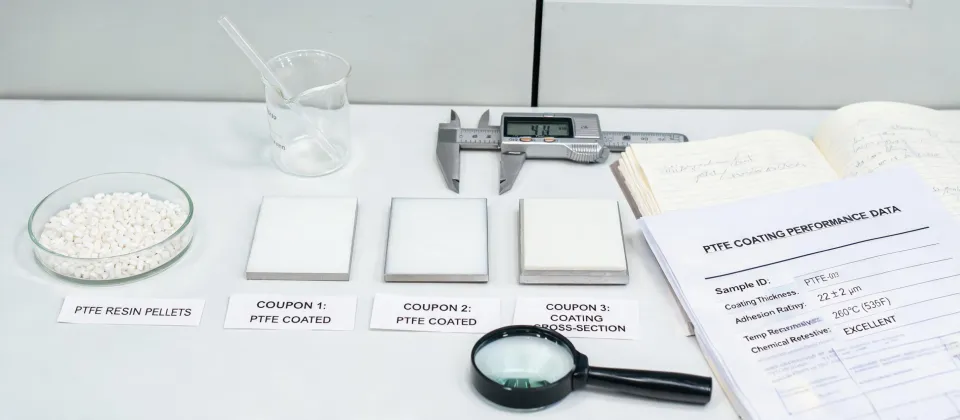
I Thought I Knew What PTFE Cost
In Q2 2024, I was staring at a spreadsheet that should have made me feel good. We'd just locked in a quote for PTFE resins that was 14% below our previous contract. My boss was happy. The engineering team was happy. I was the hero. For about two weeks.
Then the first order landed.
The material was wrong. Not catastrophically wrong—it met the spec sheet tolerances. But the part failure rate in testing jumped from 1.8% to 6.4%. That number (ugh) triggered a full audit of our Chemours products sourcing. And that audit is why I'm writing this.
I'm a procurement manager for a mid-sized industrial components manufacturer. I manage a budget of about $420,000 annually for raw materials and machined parts. Over the past 6 years, I've tracked every invoice, negotiated with 12+ vendors, and built a cost tracking system that my colleagues politely call 'obsessive.'
What I found during that audit changed how I evaluate every material decision—PTFE, nylon, you name it. And it's not what you'd expect.
The Surface Problem: Price Per Pound
When most buyers compare materials, they do what I did: calculate cost per unit. Nylon vs PTFE? Nylon wins on price. Standard fluoropolymer resins vs specialty PTFE? The commodity option looks better on the line item. Simple.
Here's what that approach misses (and what cost me $8,400 in one quarter):
The 'cheaper' material required a 12% longer cycle time in machining. Our hourly shop rate is $85. Do the math.
That's the surface problem. Everyone sees the unit price. Almost nobody calculates the total cost of ownership until after the invoice is paid and the production line is underperforming.
"When I audited our 2023 spending, I found that 23% of what I thought was 'material cost savings' actually got eaten by increased processing time, tool wear, and rework."
The Real Problem: What You're Not Measuring
This is where it gets interesting. (And by interesting, I mean expensive.)
During the audit, I pulled data from our ERP system and compared 18 months of orders across three categories: standard PTFE resins, specialty Chemours Teflon™ coatings, and nylon alternatives we'd tested for a specific project. I was looking for the obvious stuff—defect rates, lead times, price trends.
What I found was a pattern I'd missed for years.
The single biggest cost driver wasn't material price. It wasn't even processing time. It was specification mismatch.
Here's what I mean: In 2023, we ordered what we called 'PTFE' for a high-temp gasket application. The drawing called for PTFE. The purchase order said PTFE. The vendor delivered PTFE. But the specific grade—a standard commodity resin—couldn't handle the continuous 260°C exposure we needed (even though its datasheet said it could). The result: gasket failure after 90 days. Rework cost: $3,200. Downtime cost: unquantified, but significant.
I'm not a materials engineer, so I can't speak to polymer chemistry or long-term thermal degradation mechanisms. What I can tell you from a procurement perspective is this: we paid for 'PTFE' but we needed a specific PTFE formulation. The difference between a commodity resin and an optimized Chemours Teflon™ PTFE for high-temp applications isn't just a price premium—it's a difference in application performance that directly hits your bottom line.
The Hidden Cost Multiplier
Once I identified the pattern, I found three specific cost categories that don't show up on a standard material quote:
- Tooling wear differential: PTFE resins with inconsistent filler distribution wore our cutting tools 40% faster than premium grades. Tooling costs for that line jumped from $1,200/quarter to $1,900/quarter.
- Inspection rework: When spec tolerances are tight (think ±0.005 inches for PTFE machined parts), material consistency matters. The 'budget' PTFE batch had a 7% out-of-spec rate vs. 1.2% for Chemours PTFE resins. Each failed part costs us $18 in inspection time alone.
- Vendor qualification overhead: Every new material or vendor requires qualification testing. That's engineering time, test fixture setup, documentation. When I tracked it, each new qualification cost us roughly $1,800 in internal labor. If the material fails in production? That's a requalification—another $1,800.
The 'savings' from switching to a cheaper PTFE source disappeared completely once these factors were included. Actually, they reversed. The total cost of using the wrong PTFE was 12-17% higher than sticking with the optimized Chemours product.
The Cost of a Bad Decision (In Real Numbers)
Let me make this concrete. In early 2023, we evaluated nylon vs PTFE for a series of wear strips used in a packaging machine. The initial comparison was straightforward:
- Nylon 6/6 rod stock: $4.20 per linear foot
- PTFE (commodity grade) rod stock: $8.90 per linear foot
- Chemours Teflon™ PTFE (engineered grade): $11.40 per linear foot
On paper, nylon looks like the easy choice. And for some applications, it is. But for this specific use—continuous sliding contact at 120°C with occasional chemical exposure—nylon failed in 6 weeks. The first batch of 50 strips cost us $210 in material. The replacement (including labor, downtime, and expedited shipping) cost $1,400. Total: $1,610 vs. the $570 we would have spent on the Teflon™ PTFE option upfront. (Not that I'm keeping score).
The lesson wasn't 'nylon is bad.' It was 'material selection based on unit price alone is a gamble with your production budget.'
The Solution (Short Version)
After that audit, I implemented a simple policy change: every material purchase over $2,000 requires a total cost analysis that includes processing time, tooling impact, failure risk, and qualification costs. It takes maybe 30 minutes per decision. It has saved us roughly $15,000 in the past 9 months.
For PTFE specifically, here's what I've learned:
- If the application involves temperature above 200°C or chemical exposure, don't economize on the PTFE grade. The cost of failure is too high.
- The licensed applicator network for Chemours Teflon™ coatings exists for a reason—application matters. A coating that's improperly applied costs more than the premium for a certified applicator.
- PTFE is a fluoropolymer, but not all fluoropolymers are the same. If you're comparing PTFE vs FEP or PFA, make sure the comparison includes processing requirements, not just material properties.
And if someone quotes you a price that seems too good to be true for PTFE resins or machined parts? Run the TCO. I promise you, the hidden costs are in there somewhere.
I still use nylon for many applications (and commodity PTFE for non-critical parts). But now I know the difference between a material's price and its real cost. Period.
