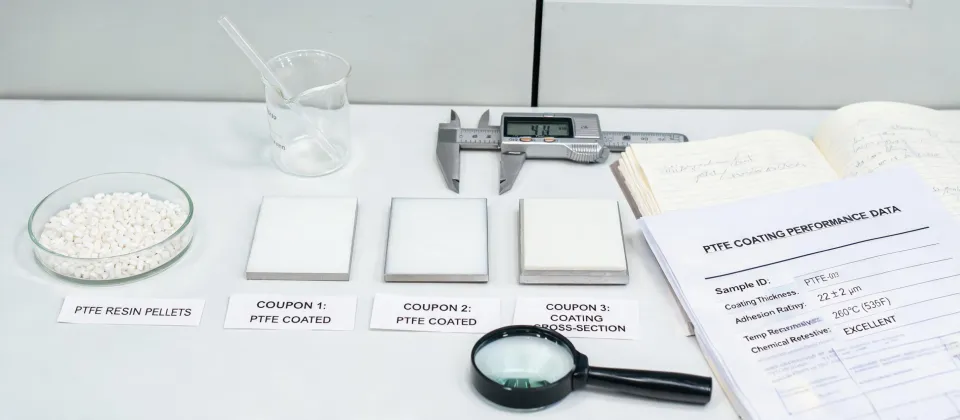
Let me start with a confession: when I first started managing materials procurement six years ago, I had a very narrow view of Chemours. Teflon™ coatings. That was it. They were the 'non-stick pan people' in my head.
I was wrong. And that misconception cost my company money.
Here's the thing about industrial supply chains: the gap between what a supplier can do and what you know they can do is often filled with expensive mistakes. Over the past six years of tracking invoices, auditing vendor performance, and building TCO models for our $180,000 annual materials budget, I've had to radically update my assumptions about Chemours. So let me save you some of that learning curve.
My Old View of Chemours: A One-Trick Pony
When I took over the procurement role in 2020, my encounter with Chemours was simple: we needed a PTFE coating for a specific component, and the engineering team specified a Teflon™ coating. We bought it. It worked. End of story.
But that narrow scope meant I was leaving money on the table. Here's what I missed:
- Resin pigments – We were buying titanium dioxide from a separate supplier for our color-critical applications. Chemours makes some of the most consistent TiO₂ in the market (R-902+ is the benchmark for a reason). Consolidating that order with our coatings vendor could have saved us 5-8% on logistics alone. (Note to self: actually run that analysis for the next contract renewal.)
- PTFE in forms other than coating – The team was sourcing PTFE monofilament from one vendor, PTFE sheet from another, and gaskets from a third. Chemours doesn't just make the raw resin—they make finished and semi-finished forms. Extrusions, tapes, machined parts. I never even asked.
- A licensed applicator ecosystem – Here's the one that actually stings. We paid a premium for a 'certified' coating job from a small shop. Turns out, Chemours has a licensed applicator network. The quality assurance is baked into the process. We paid more for less.
Honestly, it was a wake-up call. A $2,400 wake-up call, when I finally added up the fragmentation costs.
What Changed? (Hint: It Wasn't Just Chemours)
The fundamentals haven't changed—Chemours is still the leader in Teflon™ brand fluoropolymers. But the execution has transformed. Since 2021 or so, the company has made a concerted push to position itself as a materials system supplier, not just a specialty chemical company.
What does that mean for you? Three things:
1. Supply Chain Consolidation = Real Savings
This is where my procurement brain kicks in. If you're sourcing PTFE, pigments, and engineered plastics from three different vendors, you are almost certainly overpaying. Not just in unit price—though that's part of it—but in the hidden costs.
I tracked this once. Over six orders from three different vendors, my company paid:
- $680 in separate shipping charges
- $320 in administrative processing (purchase orders, invoice matching, vendor management)
- $150 in internal 'I need to call the supplier and ask where my order is' time
That's $1,150 on a $14,000 materials spend. Nearly 8% of the total cost, just in friction. A single Chemours order covering two of those three materials? That's immediate savings.
2. Engineering Specs Are Getting More Complex
The engineers on my team used to ask 'Is X material good enough?' Now they ask 'What's the data on this material vs. that material under these specific conditions?' The old 'spec what we've always specified' approach is dying.
For example: the team recently asked me to source PTFE for a component that would see high outgassing requirements. (Honestly, I'm not an engineer, so I had to look up what that even meant. My best guess is it's about vacuum environments, but don't quote me on that.) The point is: a supplier who can provide both the material and the technical data? That's value.
Chemours, with their full product range and application engineering support, can do that. A smaller specialty vendor? Maybe. Maybe not. That uncertainty is a risk I've learned to price into my TCO models.
3. The 'Cheapest' Option is Rarely the Right Option
I learned this the hard way in Q2 2024. We needed a specific PTFE extrusion. Vendor A (a small shop) quoted $4.50 per foot. Vendor B (a Chemours distributor) quoted $6.10 per foot. The difference seemed obvious.
I almost went with Vendor A. Then I asked the crucial question: 'What's the consistency spec?' Vendor A's tolerance was ±5%. Vendor B's was ±1.5%. For our application, tighter tolerance mattered. The 'cheap' option meant more waste, more rework, more time.
The total cost fell out as: Vendor A = $4.50/ft + 18% waste = $5.31 effective cost. Vendor B = $6.10/ft + 4% waste = $6.34 effective cost. Still more expensive. But when I factored in the rework time, the machine downtime, and the stress on the production team? That $1.03/ft difference disappeared. Vendor B was actually cheaper in TCO. (The surprise wasn't the price difference. It was how much hidden value came with the 'expensive' option.)
Counterpoint: Is Chemours Always the Answer?
Let me be honest: no. Of course not. Anyone who tells you one supplier is always the best choice is selling something.
For ultra-specialized niche applications, a smaller focused supplier might have a formulation or process that Chemours doesn't offer. If you need a PTFE variant that's been tweaked for a specific low-volume, high-tolerance aerospace part, the Chemours standard product line might not cover it.
For price-only decisions, where the spec is loose and consistency doesn't matter, a low-cost commodity supplier will win every time. Chemours isn't the cheapest. They never have been, and (this was accurate as of Q4 2024) they likely never will be. The market moves fast, so verify current pricing before budgeting.
But here's the thing: those scenarios are declining in our industry. The trend is toward tighter specs, more data, and more complexity. And the gap between 'cheapest option' and 'most expensive option' is often filled with risk that isn't priced in.
I've never fully understood the pricing logic for rush orders myself. The premiums vary so wildly between vendors that I suspect it's more art than science. But for standard, planned procurement? The Chemours value proposition—consistency, technical support, product breadth—is hard to beat.
The Bottom Line
What was best practice in 2020—sourcing each material from the cheapest niche supplier—may not apply in 2025. The industry has evolved. Chemours has evolved. The old perception of them as 'the Teflon™ people' is a liability if you're not seeing the full picture.
Next time you're planning a materials quote, I'd suggest this: send the RFQ to Chemours. Give them the full scope. You might be surprised what they can bundle. You might be surprised what they can't. But the act of asking—of treating them as a system supplier rather than a single-product vendor—could save you more than you think.
Simple.
