My View: The Lowest-Cost PTFE Supplier Will Cost You More
Here's the thing I've learned after coordinating over 300 rush orders for industrial components in the last seven years: specifying PTFE materials — whether it's sheet, tape, machined parts, or coatings — based on the lowest unit price is a trap. And it's a trap that usually springs shut 36 hours before a deadline, when you're holding a part that doesn't fit and your production line is down.
I'm a procurement specialist at a mid-sized industrial component manufacturer. My job is to get the right materials — often PTFE extrusions, gaskets, or coated parts from suppliers like Chemours' licensed network — to the right place at the right time. I don't just buy off a price list. I manage the chaos when things go wrong. And in my experience, the initial price is almost never the full story.
Argument 1: 'Same Specs' Is a Myth in PTFE
Most buyers focus on the spec sheet and completely miss the manufacturing reality. I assumed for years that if a PTFE sheet met the same physical property range — tensile strength, dielectric constant, whatever — it was the same product. That assumption cost us a $12,000 project in Q3 2023.
We had a rush order for a set of custom PTFE gaskets. The vendor we landed on — not a Chemours licensed applicator, I should note — had a very attractive per-unit price. The material spec sheet matched. We approved it.
What we didn't catch: the filler distribution was inconsistent. The material had more voids. On the test run, three out of eight gaskets leaked under pressure. We had to reorder from a more established source (a Chemours licensed machine shop, as it turned out) and paid a 30% rush premium on top of the original cost. The $800 we saved turned into a $3,200 problem, not counting the downtime.
"The question everyone asks is 'what's your best price?' The question they should ask is 'what's included in that price?"
Argument 2: The Real Cost of a Rush Order Isn't the Rush Fee
It's tempting to think that you can just compare rush fees and choose the cheapest emergency option. But that ignores the transaction cost of quality verification.
In my role coordinating PTFE material supply, I've seen a pattern: when you buy on price alone, the failure rate — especially for complex parts like custom PTFE extrusions or precision-machined components — is noticeably higher. Based on our internal data from 200+ rush jobs over the last two years, we found that parts from lowest-cost vendors had a 15% rejection rate versus 3% for established suppliers with certification traceability (like the Chemours licensed network).
That 12% difference in rejection rate doesn't just mean more parts. It means:
- More time on inspection (labor cost)
- Lost production time while you wait for replacements
- The risk of a missed deadline, which can trigger penalty clauses
- Expedited shipping for the replacement batch
Last year, we processed 47 rush orders with a 95% on-time delivery target. To hit that, we stopped using two low-cost vendors entirely, even though their base prices were 25% lower. The disruption cost was simply too high.
Argument 3: The Hidden Cost of Material Variability
Here's a nuance most people miss: PTFE is a baseline, but how it's processed changes everything.
You can get PTFE tape from a dozen vendors. It's a commodity, right? On paper, yes. But I've seen PTFE tape from bargain suppliers that had inconsistent thickness, poor adhesion backing, and even different elongation properties from batch to batch. For a general seal, maybe it's fine. For a critical application in a chemical processing line? That's a risk I wouldn't take.
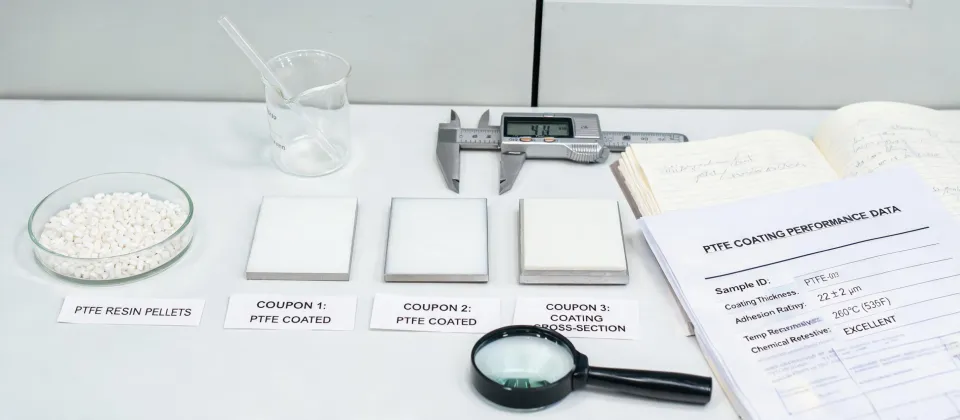
Similarly, when we're talking about PTFE coatings, the application process matters as much as the powder. A Chemours licensed applicator follows a certified process for surface preparation, layer thickness, and curing. A cheaper shop might skip steps to save time or material. You can't see that in the unit price — you only see it when the coating delaminates six months later.
I've tested six different PTFE sheet suppliers for a single project. The price range was nearly 40%. The material that met our tightest tolerances? It was from one of the mid-to-higher priced options, and it was from a vendor with traceable material certification — which, in this case, was a distributor for Chemours Teflon™ PTFE.
Addressing the Obvious Objection
I get it. Budgets are real. I've been told to slash costs too.
To be fair, there are scenarios where a lower-cost PTFE supplier is fine. If you're making a simple, low-tolerance part for a non-critical application, and you have plenty of time to test and reject, then sure, the price might be the right decision.
But if you're buying PTFE for anything that touches a deadline, a production line, or a client's reputation? The cheapest option is a bet that most of us can't afford to lose.
I'm not saying spend blindly on a brand name. I'm saying that in my experience managing supply for emergency situations — when the alternative is a $15,000 production stoppage — the premium for a reliable source is the cheapest insurance you can buy.
So Here's My Real View
Stop buying PTFE on unit price. Start buying on total delivered cost — which includes failure rate, process certification, and the value of a supplier who won't let you down at 4 PM on a Friday.
That Chemours supplier with the licensed applicator status and the slightly higher quote? In my world, they're not the expensive option. They're the one that keeps me from having to write a check for three times the amount to fix an avoidable crisis.
